
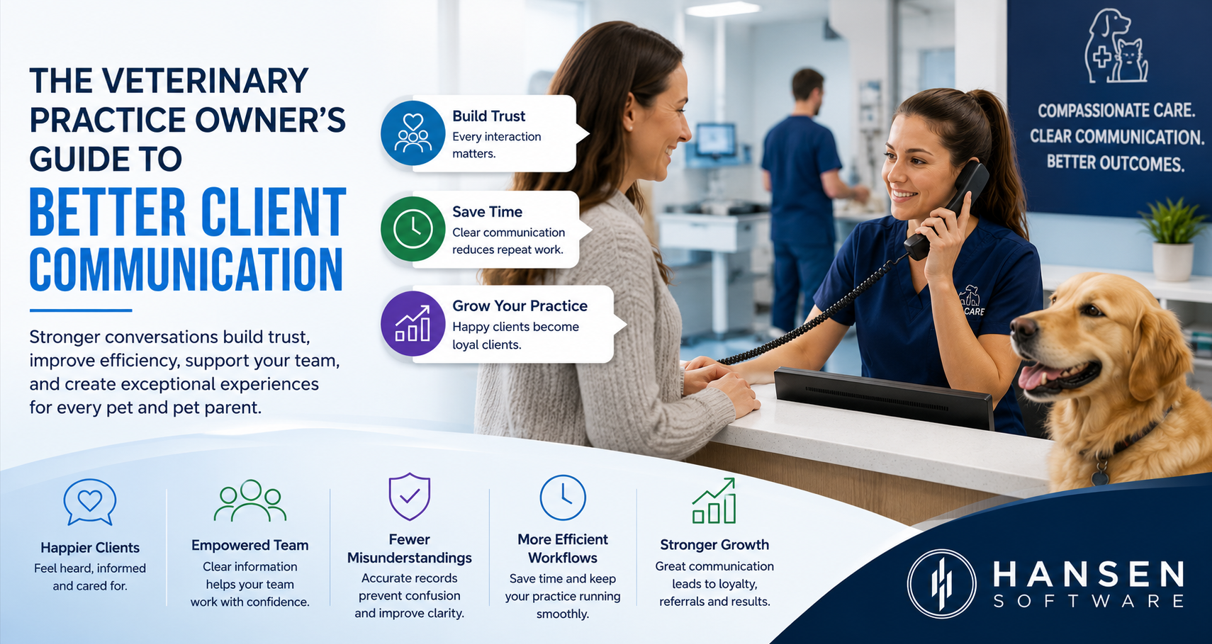
The Client Experience Begins Before the Appointment
When veterinary practice owners think about client experience, they usually picture what happens inside the clinic: the waiting room, how long clients wait to be seen, the conversation with the veterinarian, the follow-up after treatment.
All of that matters. But one of the most important parts of the client experience happens before anyone walks through the door: the phone call.
For most practices, the phone remains the primary channel clients use to schedule appointments, ask questions, discuss symptoms, request refills, or seek reassurance during a stressful moment. Whoever answers that call is often the first representative of the practice a client encounters — and that interaction shapes what happens next. A client who feels heard is more likely to trust the practice. A client who feels rushed or dismissed may decide to look elsewhere.
Improving veterinary client communication doesn't require overhauling how a practice operates. It usually starts with paying closer attention to the conversations already happening every day.
Why Veterinary Communication Is Harder Than It Looks
Answering a veterinary phone line looks simple from the outside — the phone rings, someone answers, the appointment gets booked. Reception teams know better.
A single morning might include a new puppy owner asking about vaccines, a client worried about vomiting, a prescription refill request, a question about dental costs, and an emergency caller whose dog just collapsed. Each of those calls needs something different: information, reassurance, empathy, a clear next step, or an immediate instruction to come in now. And reception staff are handling all of it while checking clients in, processing payments, and coordinating with technicians. When the phones get busy, communication easily shifts from intentional to reactive.
Answering a Call Isn't the Same as Helping a Client
A call can be technically successful and still leave a client unsatisfied. The question gets answered, the appointment gets booked — but did the client feel heard? Did they understand what to do next? Did the conversation build their confidence in the practice, or just get them off the phone?
That distinction matters more in veterinary medicine than in most industries, because clients aren't just purchasing a service. They're entrusting the health of an animal they consider family, which makes the emotional quality of the conversation as important as its content.
Trust Is Built Through Consistency, Not One Good Call
Trust with veterinary clients rarely comes from a single impressive interaction — it comes from every touchpoint reinforcing the last one. A client calls and gets a warm, professional response. They arrive and are greeted by someone who already knows why they're there. The technician remembers what was discussed on the phone. The veterinarian has the context needed to start the conversation productively. That continuity tells clients the practice is paying attention, and it's what eventually turns a one-time visitor into a loyal client — not better equipment or a nicer building, but the sense that the people caring for their pet actually listen.
The opposite is just as visible. When a client has to repeat their concern to three different staff members, receives conflicting answers depending on who picks up the phone, or isn't sure who's supposed to follow up, even small breakdowns create the impression that the practice is disorganized. Consistency doesn't mean every employee uses identical wording — it means the underlying information and expectations stay the same no matter who answers the phone, particularly around appointment policies, prescriptions, payment, and emergency procedures.
The Problem Often Isn't the Client Call — It's the Handoff Between Staff
Client communication doesn't only happen between a receptionist and a pet owner; it also happens between employees. A client explains their concern once to the person booking the appointment, again to the technician, and again to the veterinarian. When that information doesn't transfer cleanly, the client repeats themselves, staff waste time reconstructing context, and small inefficiencies compound throughout the day. Fixing this rarely means adding meetings or paperwork — usually it just means making information that already exists easier to find.
When a Client Says, "That's Not What I Was Told"
Few conversations are harder than the one where a client is certain they were told one thing — a price, a medication instruction, an appointment time — and a staff member remembers it differently. Most of the time nobody did anything wrong; people simply remember conversations differently, especially emotional ones.
This is where veterinary call recording earns its keep. A recording gives the practice an objective reference point for what was actually said, and the goal isn't to assign blame — it's to establish clarity quickly, instead of it becoming a "he said, she said."
Call Recording as a Coaching Tool
The most valuable use of call recording may have nothing to do with resolving disputes. It's training. A manager can talk about empathy and active listening for hours, but a real recorded example of an experienced staff member calming an anxious client or explaining a difficult policy teaches the same lesson faster and more concretely. The goal isn't to make every employee sound identical — it's to give new staff a working model of what effective communication actually sounds like, which is hard to simulate in a training manual when so much of veterinary work involves emotionally difficult moments.
Good Communication Includes Saying No
Excellent client service doesn't mean giving every client what they ask for. Sometimes a client wants an appointment slot that isn't available, a medication that requires an exam first, or pushes back on a recommended procedure or the practice's payment policy. The goal isn't to avoid those conversations — it's to handle them respectfully, explaining the reasoning clearly enough that the client feels heard even when the answer is no. Empathy and boundaries aren't in conflict; a practice can hold both at once.
AI Transcription Makes Recorded Calls Actually Useful
Call recording has always had one practical problem: nobody has time to listen back to hundreds or thousands of stored calls. AI transcription solves that by turning conversations into searchable text. Instead of replaying an entire call to investigate a client concern, a manager can search the transcript for the relevant moment and jump straight to it, or scan an AI-generated summary for the gist. For a busy practice, that turns a pile of recordings from a compliance archive into something a manager will actually open.
Better Communication Saves Staff Time, Too
Client experience isn't the only thing at stake — staff time is just as real a cost. Every minute spent re-explaining information, replaying long recordings to reconstruct a conversation, or answering a question that should have been clarified earlier is a minute not spent on patient care. Searchable transcripts, clearer internal handoffs, and less repetition all free up time that can go back to the clients and animals who need it.
Communication Problems Are Often Operational Problems in Disguise
Sometimes what looks like a communication issue is really an operational one showing up in conversations. If clients keep asking why there's a three-week wait for appointments, the fix isn't a better phone script — it's capacity. If callers frequently ask about payment plans, maybe that information needs to be easier to find on the website. If clients keep misunderstanding discharge instructions, the instructions themselves probably need revising. Listening to real conversations at scale can surface these patterns faster than internal meetings ever will — your clients are already telling you what isn't working; you just need a way to listen.
Surveys Show What Clients Report. Calls Show What Actually Happened.
Client surveys are useful, but they only capture what someone chooses to report after the fact — not what happened during the interaction itself. Call analytics fill that gap: call volume patterns, missed calls, hold times, and how conversations are actually handled. Combined with survey feedback, this gives a practice a much fuller picture, and starts to answer not just whether clients are satisfied, but why.
What Practice Owners Can Start Doing Today
Improving communication doesn't require a major technology investment to start. Ask your team which calls are hardest, where misunderstandings tend to happen, and which questions come up over and over — then look for the patterns. If you're already recording calls, use them for coaching rather than surveillance, and look for examples of great communication as often as you look for what needs fixing. The goal is a culture where communication is treated as a skill the team keeps getting better at, not a box to check.
Technology can support that process — call recording provides visibility, transcription makes it searchable, analytics reveal patterns — but none of it replaces empathy or judgment. It just gives your team better information to act on.
How Hansen Software Supports Better Veterinary Communication
Hansen Software has spent more than 30 years helping organizations manage and understand their telephone communications, and that experience now extends into AI-powered transcription and conversation analysis built for veterinary practices.
In practice, that means a manager investigating a disputed medication instruction can search a transcript for the relevant phrase and find it in seconds, instead of replaying a twelve-minute call. It means a practice can pull every call that mentions "payment plan" from the last month to see how consistently staff are explaining it. And it means new hires can review real examples of strong client conversations instead of learning entirely on the job.
Hansen Software's tools let practices record calls, generate searchable transcripts and summaries, and surface communication patterns — so teams spend less time reconstructing conversations and more time acting on what they've learned. The goal isn't to make veterinary communication less personal. It's to remove the administrative friction around it, so staff have more time and better information to focus on the clients and patients in front of them.
Final Thoughts: Better Communication Is Better Veterinary Care
Client experience isn't separate from patient care — it is patient care. A worried pet owner needs reassurance before they arrive. A client weighing treatment options needs clear information before deciding. A family receiving hard news needs compassion throughout the call. Technology can help a practice understand its conversations better, but the goal underneath all of it is simple: listen carefully, communicate clearly, and make every conversation count.
Frequently Asked Questions
How can veterinary practices improve client communication? Start by understanding how communication currently works. Set clear standards, coach regularly, review challenging conversations, and use call analytics to spot where clients and staff are hitting unnecessary friction.
What is veterinary call recording used for? Staff training, quality assurance, communication review, dispute resolution, and operational improvement. Practices should confirm their recording practices comply with applicable consent and privacy laws.
How does AI transcription help veterinary clinics? It converts calls into searchable text and generates summaries, so staff and managers can find and understand important information without listening to an entire recording.
Can better communication improve veterinary client retention? Yes. Clients build long-term relationships with practices where they feel listened to, respected, informed, and supported — and consistent communication is one of the clearest ways to signal that.
How can veterinary practices save staff time through better communication? Reduce repeated conversations, make existing information easier to find, identify recurring client questions, and use AI-generated summaries to cut down on manual review time.