
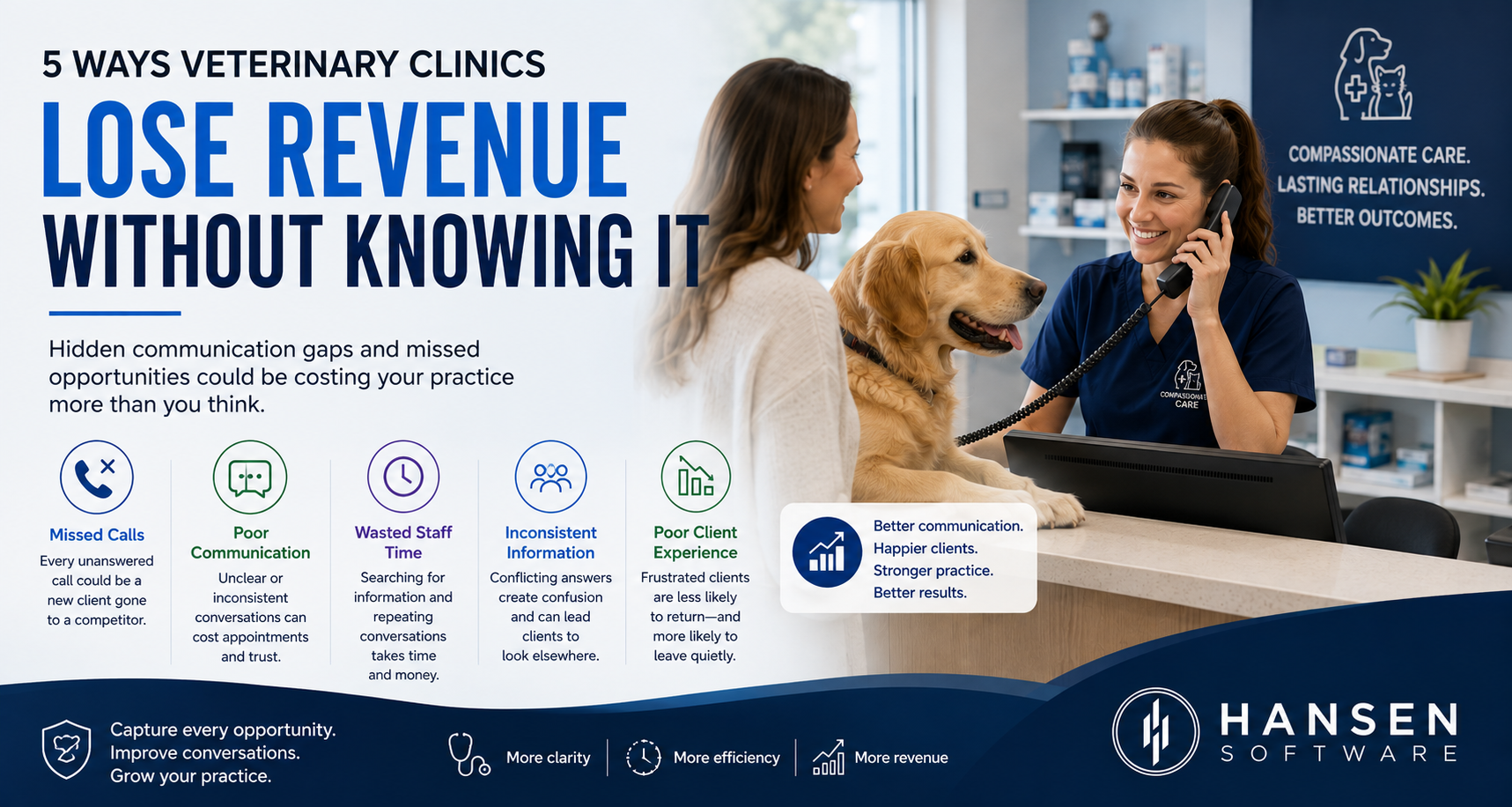
5 Ways Veterinary Clinics Lose Revenue Without Knowing It
The Hidden Connection Between Missed Calls, Communication Gaps, Staff Time, and Client Experience
Veterinary practice owners spend a great deal of time thinking about revenue. They have to. Running a successful practice means balancing the cost of veterinary professionals and support staff, equipment, medications, facilities, technology, continuing education, and countless other expenses while still providing an exceptional level of care to patients and their families.
Most practices have systems in place to monitor the financial side of the business. They review invoices, track appointments, monitor inventory, analyze revenue by service, and keep a close eye on expenses. But there is another side of practice revenue that can be much harder to see: the revenue that disappears before it ever becomes a transaction.
A phone call that isn't answered. A prospective client who decides to call another clinic. A client who doesn't fully understand a treatment recommendation. A staff member who spends twenty minutes trying to determine what was discussed during a previous conversation. A client who becomes frustrated by repeated communication problems and eventually chooses another veterinary hospital.
None of these events necessarily appear on a financial statement as lost revenue. Yet collectively, they can have a meaningful effect on the financial health and long-term growth of a veterinary practice.
The challenge for practice owners is that these losses are often hidden in plain sight.
Revenue Loss Doesn't Always Look Like Revenue Loss
When a veterinary practice spends more than expected on supplies or equipment, the impact is relatively easy to identify. It appears as an expense and can be addressed through budgeting and financial analysis. Communication-related losses are different because they often occur before an appointment, invoice, or client relationship ever exists.
Imagine a prospective client searching online for a veterinarian for a new puppy. They find your website, read your reviews, and decide your practice looks like a good fit. They call, but the receptionist is helping another client at the front desk and nobody is available to answer. The caller waits for a while, eventually hangs up, and tries another clinic.
There may be no record indicating that your practice lost a client. From an accounting perspective, nothing happened. There was no appointment to cancel and no invoice to lose.
But something did happen.
Your marketing successfully generated an opportunity, and the practice wasn't able to capture it.
The same thing can happen with existing clients. Someone calls with a question about a procedure, a medication, a follow-up appointment, or a concern about their pet's symptoms. If the experience leaves them confused or frustrated, they may hesitate to move forward with recommended care or begin looking elsewhere for their veterinary services.
This is why the financial impact of communication deserves more attention than it often receives.
1. Missed Calls Can Become Missed Clients
The telephone remains one of the most important communication channels for veterinary practices. Clients call because they need something that often feels important to them in that moment: an appointment, advice about a symptom, information about a service, a prescription refill, an estimate, or guidance about whether their pet needs urgent care.
For new clients in particular, that first call can be the beginning of a relationship that lasts for many years.
Consider a new puppy. The first appointment may lead to vaccinations, wellness examinations, parasite prevention, spaying or neutering, dental care, diagnostics, and routine treatment throughout the animal's life. The value of that client relationship isn't limited to the revenue associated with the initial visit.
That's why a missed call can represent far more than one missed appointment.
A practice may have invested substantially in its website, search engine optimization, advertising, social media, online reviews, and community reputation to convince that person to pick up the phone. If the caller cannot reach someone when they are ready to make contact, all of that investment may fail at the final step.
This is particularly important in a competitive market where pet owners often have several veterinary practices within a reasonable distance. If one clinic doesn't answer, another is usually only a few minutes away.
The solution isn't necessarily to answer every call instantly. That's unrealistic for many veterinary teams, especially during busy periods. The more important question is whether the practice understands what is happening to those calls and whether there are opportunities to improve the way they are handled.
A practice can't improve what it can't see.
The Lifetime Value of a Veterinary Client Matters
It is easy to underestimate the financial impact of losing a prospective client because the first transaction may be relatively small. A new-client examination might only represent a fraction of the value that relationship could eventually generate.
Over the course of a pet's life, that same client may purchase routine examinations, vaccinations, medications, dental services, diagnostics, surgery, preventive care, and treatment for unexpected illnesses or injuries. They may also bring additional pets to the practice and recommend the clinic to friends and family.
This is why veterinary practices should think about client acquisition in terms of relationships rather than individual appointments.
When someone calls your practice, they aren't simply asking for a time slot on the schedule. They may be deciding whether your team is the group they want caring for their pet for years to come.
The quality of that first conversation matters.
2. Poor Communication Can Cause Clients to Walk Away
Not every lost client is the result of a missed call. Sometimes someone answers the phone, provides the requested information, and completes the interaction, yet the client still walks away feeling uncertain or dissatisfied.
Perhaps the client didn't understand why a diagnostic test was recommended. Maybe they weren't clear about the expected cost of treatment or what would happen next. Perhaps they felt rushed because the employee answering the phone was dealing with several competing demands.
These situations can be difficult for practice owners to identify because, on paper, the call may look successful. It was answered. The question was addressed. An appointment may even have been booked.
But client experience is about more than whether a task was completed.
Veterinary medicine is an unusually emotional form of healthcare. Clients are making decisions about animals they love, often while they are worried, frightened, or uncertain. The way information is communicated can have a significant influence on how much confidence they have in the practice and its recommendations.
This becomes particularly important when a veterinarian recommends diagnostics, treatment, surgery, or another service that carries a meaningful cost. A client who understands the medical reasoning behind a recommendation is in a much better position to make an informed decision than someone who simply hears a price and doesn't understand why the service is necessary.
The goal isn't to persuade clients to spend more.
The goal is to make sure they have the information they need to understand their options.
Good communication can benefit both sides of that conversation. Clients feel better informed, and veterinary teams have a better opportunity to provide appropriate care.
Communication Problems Can Become Business Problems
This is where veterinary client communication becomes more than a customer-service issue.
When clients repeatedly misunderstand the same policy, ask the same question, or hesitate over the same recommendation, the practice may have an opportunity to improve the way information is being delivered.
For example, if clients regularly call because they don't understand how prescription refills work, the answer may not be to simply have receptionists explain the policy more often. The practice could also examine whether the policy is clearly communicated during appointments, whether written instructions are easy to understand, or whether information on the website needs to be improved.
If clients frequently question estimates, perhaps the issue isn't that they are resistant to veterinary care. They may simply not understand what is included in the estimate or why certain services have been recommended.
Communication can therefore provide a window into the larger operation of the practice.
The questions clients ask may reveal where the business itself needs to improve.
3. Staff Time Is One of the Most Expensive Hidden Costs
Revenue can also be affected by the amount of time employees spend searching for information, returning calls, clarifying previous conversations, and trying to reconstruct what happened earlier in the day.
None of these tasks are inherently unnecessary. Communication is an essential part of veterinary medicine. The problem arises when staff repeatedly spend time recreating information that has already been communicated.
Consider a client who calls several days after an appointment and says, "I was told I should call back if this happened, but I can't remember exactly what the technician said."
The employee answering the phone may need to search the patient's record, ask another staff member what they remember, or locate a previous call and listen to it from beginning to end if a recording exists.
Now imagine that happening dozens of times a week.
The individual interactions may only consume a few minutes, but the cumulative cost can become substantial. More importantly, those are minutes that could have been spent helping another client, assisting the clinical team, or caring for patients.
This is one of the reasons technology that makes conversations easier to access can have a practical operational benefit.
Making Existing Information Easier to Find
Traditional call recording provides an accurate record of what was said, but recordings themselves can be difficult to search. If a manager needs to find one particular statement within a ten-minute conversation, someone still has to listen to the call.
AI transcription changes that process by converting the conversation into searchable text.
Instead of listening to an entire recording, a team member can search for a relevant word or phrase and quickly locate the section that matters. AI-generated summaries can provide additional context without requiring someone to review every second of the conversation.
For a veterinary practice, this can be especially useful when a client needs clarification about something previously discussed.
The objective isn't to create more administrative work. It's to make information that already exists significantly easier to retrieve.
For a busy veterinary team, that distinction can make a considerable difference.
4. Inconsistent Communication Can Create Expensive Problems
Veterinary practices are complex organizations made up of people with different roles, experience levels, communication styles, and responsibilities. Receptionists, technicians, veterinarians, practice managers, and other employees may all interact with the same client throughout a single episode of care.
That is perfectly normal.
The problem occurs when important information isn't communicated consistently between those people.
A client may receive one answer from reception and a different explanation from another employee. A policy may be described differently depending on who happens to answer the phone. A follow-up expectation might be discussed during one conversation but not passed along to the next person who speaks with the client.
Even when everyone is acting in good faith, inconsistent communication can create confusion.
And confusion can become expensive.
A client who doesn't know what is expected of them may miss an appointment. Someone who isn't clear about a treatment recommendation may delay care. A client who receives conflicting information may lose confidence in the practice.
In more serious situations, disagreements can arise about what was actually discussed during a previous conversation.
Having an accurate record of important telephone conversations gives the practice an objective source of information. Instead of relying entirely on memory, staff can review what was actually communicated.
That isn't about looking for someone to blame. It's about establishing clarity.
Call Recording Should Be Used to Improve Teams, Not Police Them
There is an important cultural distinction when introducing veterinary call recording into a practice.
If employees believe recordings exist primarily to catch them making mistakes, the technology can create anxiety and resistance.
Used properly, however, call recording can become a powerful training and coaching tool.
A practice manager might discover that one receptionist has an exceptional way of calming anxious clients. Another employee may be particularly effective at explaining a complicated policy without making the caller feel dismissed. Someone else may have developed an excellent approach to handling difficult conversations about cost.
These are skills worth sharing.
Real conversations provide examples that are much more meaningful than generic role-playing exercises. Teams can discuss what worked, why it worked, and how those techniques might be applied in other situations.
The goal is not to make every employee sound the same.
It's to help everyone become more confident and effective communicators.
5. A Poor Client Experience Can Cost More Than One Appointment
Perhaps the most difficult financial loss to measure is the client who leaves without telling you why.
They don't necessarily complain. They may not leave a negative review. They simply stop booking appointments.
Perhaps they found the practice difficult to reach. Maybe they felt rushed during a phone conversation. Maybe they didn't understand something that was explained to them. Or perhaps another practice offered an experience that felt more convenient or personal.
By the time the practice notices that client hasn't returned, the reason may be impossible to determine.
This is why client experience should be considered even when there aren't obvious complaints.
A lack of negative feedback doesn't necessarily mean everything is working perfectly. Sometimes it simply means the client didn't think it was worth explaining why they left.
Client Loyalty Is Built Through Hundreds of Small Interactions
Client loyalty isn't usually created by one extraordinary moment.
It develops over time through repeated experiences.
The receptionist remembers the client's name. The technician understands what happened during the previous visit. The veterinarian takes time to answer questions. The staff member follows up when they said they would. The client calls and knows they will be treated with patience and respect.
Each interaction reinforces the relationship.
Communication is present in nearly every one of them.
That is why improving telephone communication isn't simply about making the phone system more efficient. It is about improving one of the most frequent points of contact between the practice and the people who trust it with their pets.
The Conversations Your Practice Already Has May Contain the Answers
Veterinary practices already collect enormous amounts of operational data. They know how many appointments are booked, how much revenue is generated, which services are most popular, and when the practice is busiest.
Telephone conversations provide another type of information.
They can reveal what clients are asking about, where they are confused, what services they're interested in, when demand exceeds staffing capacity, and what questions repeatedly require staff attention.
When call reporting, recording, and AI transcription are combined, those conversations become another source of operational intelligence.
Instead of treating the telephone simply as a way to communicate, practices can begin using it to understand their business.
That can lead to better decisions about staffing, training, workflows, client education, and service delivery.
Start With Questions Before Looking for Technology
A veterinary practice doesn't need to start by purchasing new technology.
It can start by asking better questions.
Are we missing calls during particular periods of the day? Are new clients having difficulty reaching us? What questions do clients ask repeatedly? Where do misunderstandings happen most often? Are staff spending too much time searching for information? Are clients receiving consistent answers regardless of who answers the phone?
Those questions can reveal where the actual problems are.
Technology is valuable when it helps a practice answer those questions more effectively.
Rethinking the Connection Between Communication and Revenue
Revenue doesn't begin when a client pays an invoice.
It begins much earlier.
It begins when someone discovers your practice, decides to call, reaches your team, and has an interaction that makes them feel confident enough to take the next step.
From there, communication continues to influence whether they accept recommendations, return for future appointments, bring additional pets to the practice, and recommend the clinic to others.
That's why communication shouldn't be viewed as a separate customer-service function.
It is part of the business.
And for veterinary practices, it is closely connected to the client relationships that ultimately sustain the practice.
How Hansen Software Helps Veterinary Practices Understand Their Calls
For more than 30 years, Hansen Software has helped organizations better understand their telephone communications through call reporting and call recording technology. Today, that capability extends to AI-powered transcription, searchable conversations, and automated summaries.
For veterinary practices, these tools can provide a clearer picture of what is happening before, during, and after a phone call. Practices can identify missed-call patterns, review conversations for training and quality improvement, find information more quickly, and gain greater insight into the questions and concerns clients bring to the practice.
The purpose isn't to replace the human side of veterinary medicine. It's to give veterinary teams better information so they can spend less time reconstructing conversations and more time helping the clients and patients who depend on them.
Sometimes the biggest opportunities for improvement aren't sitting inside a financial report.
They're sitting inside the conversations your practice is already having every day.
Final Thoughts
Veterinary practices don't necessarily lose revenue because of one obvious mistake. More often, opportunities disappear through small communication gaps that are difficult to see when you're focused on the day-to-day demands of running a busy hospital or clinic.
A missed call can mean a prospective client goes somewhere else. An unclear treatment explanation can leave a client hesitant about recommended care. A staff member searching for information can spend valuable time on an administrative task that should have taken minutes. Inconsistent communication can create confusion, while a series of small frustrations can eventually cause a loyal client to leave.
Individually, these events may not seem significant.
Across hundreds or thousands of client interactions, however, they can add up.
The practices that recognize this aren't necessarily the ones trying to sell more services. They're the ones trying to understand their clients, their teams, and their operations more clearly.
Because before revenue appears on a financial report, there is usually a conversation that came first.
And understanding those conversations can be one of the most overlooked opportunities a veterinary practice has to improve both its client experience and its business.
Frequently Asked Questions
How can a veterinary practice identify revenue being lost through missed calls?
The first step is understanding call activity alongside appointment activity. Practices can look for patterns in unanswered calls, abandoned calls, busy periods, and new-client inquiries to determine whether there are opportunities being lost before a client ever reaches the appointment book.
Can veterinary call recording actually improve revenue?
Call recording doesn't generate revenue by itself. Its value comes from the insight it provides. Reviewing calls can help practices identify missed opportunities, improve communication, strengthen staff training, reduce misunderstandings, and create a better overall client experience.
How can AI transcription save veterinary staff time?
AI transcription converts recorded conversations into searchable text and can generate summaries, allowing staff to locate important information without manually listening through an entire call. This can be particularly useful when a client needs clarification about something discussed previously.
Is client experience really connected to veterinary practice revenue?
Yes. Client experience plays an important role in trust, loyalty, referrals, treatment decisions, and whether clients continue using a practice. Communication is one of the most consistent elements of that experience.
What should veterinary practices measure beyond traditional financial metrics?
Practices can gain additional insight by looking at missed calls, call volume, response patterns, appointment conversion, recurring client questions, client retention, and the types of conversations staff are handling most frequently. Together, these metrics can reveal operational issues that aren't visible in financial reports alone.